The Needs Behind the AI Boom
The Psychological Infrastructure of Acceleration
A day begins with a question entered into a chatbot. The response arrives within seconds, formatted and confident. A designer uses AI to generate three variations of a layout in the time it once took to sketch one. A programmer watches code appear line by line, suggestions flowing faster than thought. By midday, tasks that once consumed hours compress into minutes.
Workers using generative AI reported saving over five percent of their weekly hours, equivalent to more than two hours in a standard workweek [1]. Seventy-five percent of global knowledge workers used AI in 2024, nearly double the rate from six months earlier [2]. Speed has become baseline expectation. Documents generate themselves from prompts, meetings summarize automatically, emails draft without deliberation. The technology meets a need that existed before it arrived: to keep pace with volume, to match the world's accelerating demand for response.
Efficiency forms the visible layer. Companies measure productivity gains, track time saved, and assign valuations that assume speed equals value [3]. Yet efficiency alone cannot explain the intensity of adoption. Nearly half of new users began employing AI within six months, often without direction from management [2]. Beneath efficiency lies control: the desire to manage complexity too vast to comprehend. AI filters, summarizes, and extracts meaning, offering a sense of stability in overwhelming systems.
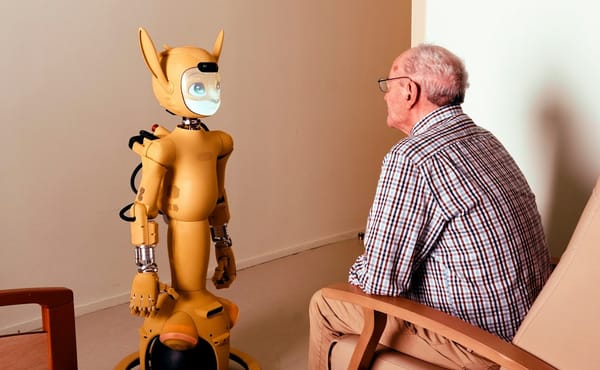
Understanding operates on a different register. People turn to AI for explanations and patterns that make experience legible. Chatbots answer questions too trivial or too personal for human inquiry, offering patience without judgment. In Japan, half of surveyed teens expressed a wish for AI companionship [4]. Downloads of AI companion apps rose by nearly ninety percent in early 2025 [5]. The technology meets not only practical needs but emotional ones: connection without demand, presence without vulnerability [6].
These needs existed long before the tools that satisfy them. Workplaces rewarded speed; institutions demanded constant responsiveness; social ties frayed under pressure. AI emerged as a relief valve, addressing symptoms more than causes. Studies of digital culture have long shown this pattern: technology offers comfort where systems resist reform [7,8]. Organizations deploy automation to manage burnout rather than redesign work. Platforms offer synthetic intimacy where communities have eroded. The system stays unchanged, only its coping mechanisms evolve.
The question is no longer what AI replaces, but what forms of dependency it quietly builds beneath the promise of relief and how long we will call that relief progress.
References
[1] Federal Reserve Bank of St. Louis. The Impact of Generative AI on Work Productivity. February 2025.
https://www.stlouisfed.org/on-the-economy/2025/feb/impact-generative-ai-work-productivity
[2] Microsoft. Work Trend Index: AI at Work Is Here. Now Comes the Hard Part. May 2024.
https://www.microsoft.com/en-us/worklab/work-trend-index/ai-at-work-is-here-now-comes-the-hard-part
[3] AIPRM. AI in the Workplace Statistics 2024.
https://www.aiprm.com/ai-in-workplace-statistics/
[4] UNICEF Innocenti. The Risky New World of Tech's Friendliest Bots. January 2025.
https://www.unicef.org/innocenti/stories/risky-new-world-techs-friendliest-bots
[5] CBC News. People Are Turning to AI for Emotional Support, Raising Concerns. March 2025.
https://www.cbc.ca/news/business/companion-ai-emotional-support-chatbots-1.7620087
[6] NPJ Mental Health Research. Experiences of Generative AI Chatbots for Mental Health Support. 2024.
https://www.nature.com/articles/s44184-024-00097-4
[7] Han, Byung-Chul. The Burnout Society. Stanford University Press, 2010.
[8] Turkle, Sherry. Alone Together: Why We Expect More from Technology and Less from Each Other. Basic Books, 2011.
All sources accessed and verified as of October 2025.